
Universities have always been the place where answers to complex questions are sought and new approaches are shaped. In recent years, one question has become increasingly important: how can we use artificial intelligence in a way that truly creates value? At TalTech, this shift has been clearly felt as well, because AI has become a part of everyday discussions, experimentation, and our shared vision.
The collective contribution of our university community
This summer played a decisive role in shaping TalTech’s AI journey. It was a joy to see dozens of colleagues from across the university come together to discuss what this journey could look like and to contribute actively. The discussions were filled with great ideas, practical insights, and honest concerns. Over the summer, the first guidelines and practical training materials were created, and a vision began to take shape. We are deeply grateful to everyone who worked on AI topics during the summer — it was true teamwork and laid the foundations for our roadmap.
Everything was new in September
In August, the new rectorate began its work, and AI matters at TalTech came under the leadership of the Vice-Rector for Academic Affairs. The AI team was joined by Kristel, the Vice-Rector’s Advisor for AI, and Julija, AI Project Manager. However, the adoption of artificial intelligence is not merely a technical upgrade that a small team can implement, it is a cultural shift that requires strong collaboration across the entire organization, new skills, open-mindedness, and a willingness to learn.
In September, we launched the TalTech AI website, which brings all AI-related information into one place. It is a space where students, lecturers, researchers, managers, and support staff can find answers to their questions about using AI. The site is still developing, but we have already received a lot of positive feedback from people within TalTech as well as from other universities and partners.
AI Champions: a Growing Community and Practical Collaboration
The AI Champions programme also took off this autumn. So far, five insightful workshops have taken place, and each session has added something valuable: a clearer understanding of how to use AI in teaching, new ideas for supporting colleagues, and honest discussions about what works and what doesn’t. The interest in the workshops has been remarkably high, showing that the people at TalTech don’t just want to observe AI developments from the sidelines, they want to share their experiences, learn from one another, and experiment in practice.
AI Roadmap Focus Areas
To support the university’s development in a coherent and strategic way, we are creating an AI roadmap and have identified four key focus areas. Each of them affects us in different ways and requires well-thought-out actions.
1. Raising awareness and developing skills
AI has become an everyday working tool, but using it effectively requires awareness, new competencies, and critical thinking. We are working to ensure that everyone at TalTech has the confidence and understanding to know what AI can be used for, what should be avoided, and what is recommended.
We have already created web-based introductory courses for students and staff, launched the AI Champions workshop series, and developed the first set of guidelines. Because the AI field is evolving at a tremendous speed, we also need to accept that the situation is constantly changing and at times there may be more questions than answers.
2. Integrating AI into the university’s core activities
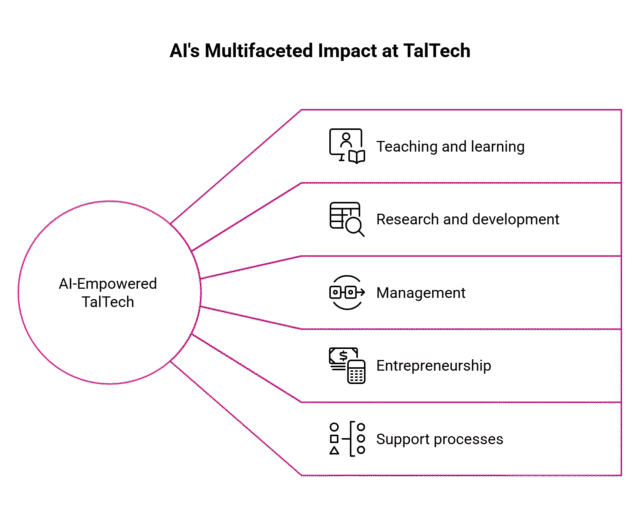
Several courses and research groups are already running their first AI pilots. We are exploring which university processes could be made smarter, how to support more data-driven decision-making, which teaching tools are worth scaling up more broadly, and how AI can assist researchers in data-intensive projects. Our goal is for AI to become a natural part of everyone’s daily work, not just an additional tool reserved for IT fields. One of the most important next steps in the near future is the adoption of the ChatGPT Edu platform, which will provide a secure and controlled environment for teaching and day-to-day work.
3. Ethical and Responsible Use of AI
The use of artificial intelligence must be ethical, responsible, and transparent. In collaboration with lecturers, data protection experts, lawyers, and students, we continuously update the guidelines that help ensure academic integrity, protect people’s rights, and safeguard our data. We are living in an exciting and rapidly changing time, where it is impossible to regulate every possible situation in advance. That is why TalTech’s goal is to strengthen our community’s awareness of both the possibilities and risks of AI, so that everyone can make informed and responsible choices.
4. Developing AI and Contributing to Society
TalTech is more than just a user of AI — we are also creators of new solutions. We actively contribute to research and innovation in a wide range of important fields. Collaboration with Estonian universities, the HPC Center, AIRE, EuroTeQ universities, and many other partners helps bring research results into real-world practice and strengthens the innovation capacity of both Estonia and Europe.
AI Council and Working Groups
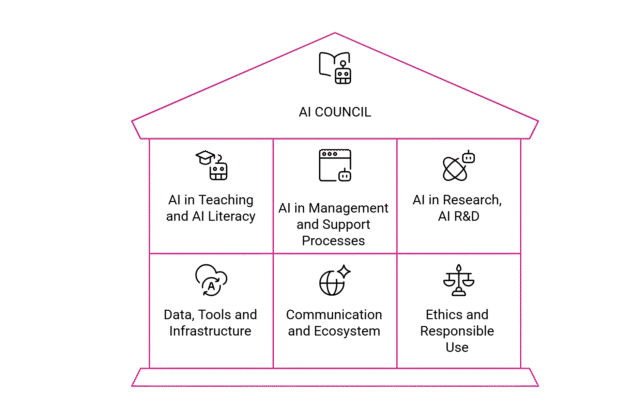
To coordinate all of these activities, we have established an AI Council and several thematic working groups. The Council provides the overall strategic direction and a shared vision for the university, while the working groups focus on specific areas: teaching and AI competencies, AI research and development, data and infrastructure, ethics, governance, and communication. The work is ongoing and the structure continues to evolve, because TalTech is a large and diverse organisation with many excellent experts. It is precisely through collaboration with these specialists that we will achieve the best results.
The Voice of Our Community: AI Awareness and Usage Survey
To ensure that the AI roadmap does not remain merely a theoretical document, we are conducting internal surveys for both staff and students. These surveys will give us a clear picture of how people at TalTech are already using AI and where they feel support or skills are still missing. This insight is essential for evaluating the impact of our activities and planning the next steps. We warmly encourage everyone to participate as the results will directly shape which initiatives we prioritise in the coming years. We will also be raffling exciting prizes among the most active units.
Link to the staff survey
Link to the student survey
What’s Coming Next?
We want to provide an environment where generative AI can be used safely, transparently, and in ways that genuinely support learning and work. One of the most anticipated steps is undoubtedly the introduction of ChatGPT Edu, which means that all TalTech employees will receive ChatGPT Edu licenses. To make this possible, Estonian universities formed a joint consortium that under TalTech’s leadership (special thanks to Raul and Gert) entered into negotiations with OpenAI. Much of the necessary work has now been completed, and we are currently waiting for the final steps from OpenAI’s partners. In parallel, we are preparing training materials, launching the first pilots in teaching and administration, and expanding opportunities for our community to experiment, learn, and incorporate AI meaningfully into everyday work.
TalTech as a Launchpad for Future-Makers
Our goal is not to chase technology, but to think alongside it, shape it and create with it. Artificial intelligence is not an end in itself, but rather an opportunity to support teaching, research, work processes and decision-making in ways that make the university stronger, smarter and more adaptable. We invite everyone at TalTech to be part of this journey. We are only at the beginning, but it is already clear that our university has both the competence and the motivation to build something truly meaningful. Let’s do it together.