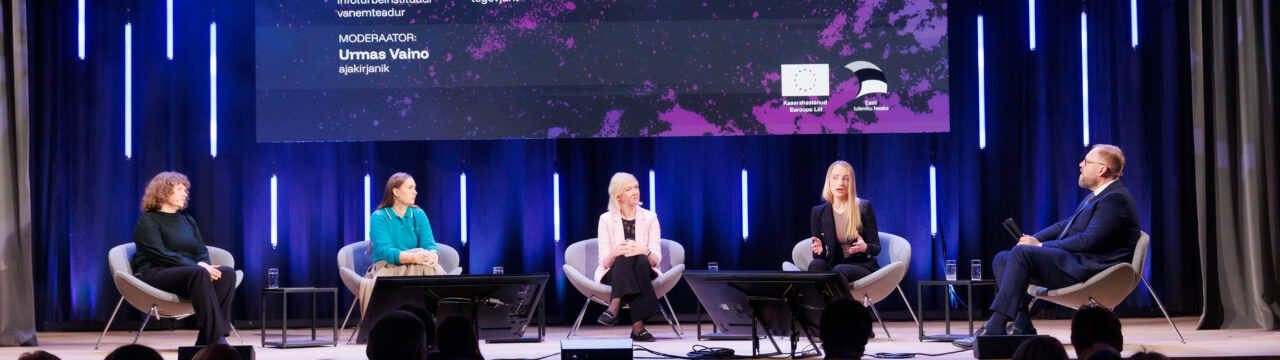
The conference “Artificial Intelligence 2026: Let’s Agree on the Boundaries of AI Use!” brought together experts from education, research, business, and the public sector to discuss the impact of artificial intelligence on Estonia’s future. Over the course of the day, one central message became increasingly clear: AI is no longer a standalone technology, but a general competence that must be systematically embedded in education—particularly within university curricula.


Photographer: Arno Mikkor
Universities as Shapers of AI Competencies
The conference discussions lead to a clear conclusion: the role of universities is no longer limited to educating narrow field-specific specialists. In the age of artificial intelligence, universities must act as shapers of competencies for society as a whole—that is, as places where technical knowledge, critical thinking, ethics, and responsible use come together.
In the context of TalTech, this means that AI competencies must be integrated across different curricula, not only within IT and engineering programmes. Future economists, lawyers, teachers, architects, and leaders need to understand how AI works, what its possibilities and limitations are, and how to apply it consciously. This does not mean that everyone must learn to code, but rather that everyone should possess AI literacy.
Future Skills and Challenge-Based Learning
The discussions also emphasized that AI is no longer merely a tool, but is systematically reshaping professions, job roles, and labour market expectations. It is clear that future skills do not emerge automatically in lecture halls anymore. Challenge-based learning is becoming increasingly important, where learners address real-life problems in collaboration with companies, the public sector, and researchers, while also making use of AI tools.
Such a learning model helps develop skills that are difficult to automate:
-
solving problems together with artificial intelligence,
-
interdisciplinary collaboration,
-
critical and systems thinking,
-
data-driven decision-making,
-
creativity and responsible use of technology.
Here, universities have a clear opportunity to take a leading role by integrating education, research, and societal challenges into a coherent whole, and by offering learners experiences that prepare them for a rapidly changing world of work.
Education, Research, and the Labour Market Must Move Together
Another important theme at the conference was the closer integration of education and the labour market. The development of AI is transforming jobs while simultaneously creating new roles. As a result, both young people and those already in the workforce need flexible learning pathways, lifelong learning opportunities, and the ability to continuously upgrade their AI and digital skills.
Universities play a key role through micro-credentials, continuing education, and collaborative projects that enable a rapid response to labour market needs and help support Estonia’s competitiveness.
Many Valuable Ideas and Directions for the Future
Throughout the day, a wealth of valuable ideas and insights emerged, ranging from ethical frameworks for artificial intelligence to very practical proposals on how AI can be used in education and leadership. The discussions showed that Estonia has both the knowledge and the ambition to make the next digital leap—but this requires clear agreements, collaboration, and the courage to implement change in education.
The Artificial Intelligence 2026 conference did not provide ready-made answers, but it did set out important directions: if we want to remain a successful and competitive digital state in the future, we must start with education—and universities, including TalTech, are on the front line of this transformation.
In the video: Kristel Kriisa, AI Advisor to the Vice-Rector of Academic Affairs