In recent years, there has been growing excitement around artificial intelligence. New tools keep emerging, key concepts change constantly, and trends evolve in a matter of weeks. One moment people are talking about prompting, the next about AI assistants, then agents, and most recently creative or “vibe” coding. Yet before simply starting to “vibe” from scratch, something much more fundamental is needed: basic knowledge, the courage to experiment, and practical experience.
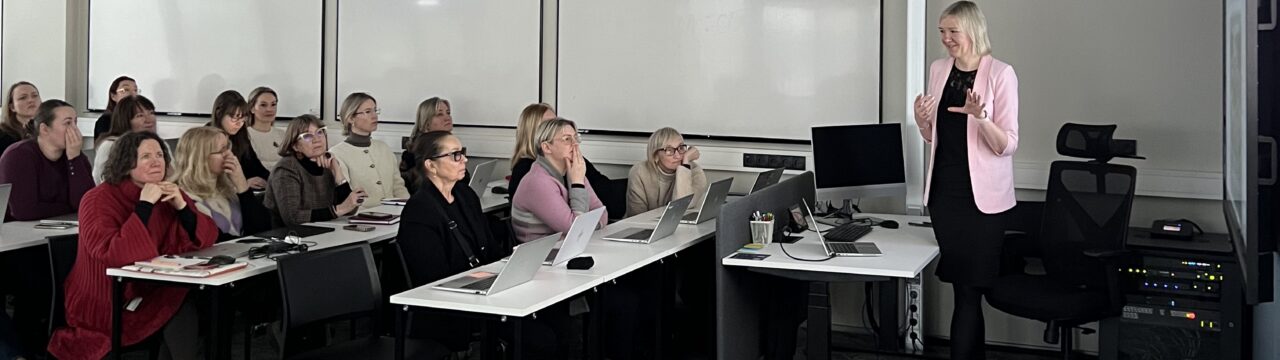
This idea also formed the basis of the ChatGPT Edu workshops held at TalTech from January to March, primarily aimed at managers and support staff. In total, 10 workshops were conducted, with over 300 employees participating. The goal was to help participants better understand how generative AI works, what it can realistically be used for, and how to apply it in their daily work in a conscious and practical way.
From my perspective as a trainer, the most striking aspect of these workshops was how quickly caution or even skepticism can turn into excitement. In nearly every session, there was a moment when someone realized that a task that usually takes hours could be completed in minutes with the help of AI. These were clear moments of realization: AI was no longer an abstract concept or just another new technological possibility, but something that could have a real impact on how we work.
One slide I showed at every training session focused on the impact of generative AI on jobs in Estonia. According to a study conducted a couple of years ago, 61% of employees will soon be working alongside AI, 5% of jobs may disappear due to generative AI, and 34% of employees will be affected only slightly or indirectly. This slide often sparked lively discussions. Many participants felt that the impact of AI may already be greater than what was predicted two years ago. This reflects a broader shift: AI is no longer a topic of the future, but an increasingly important part of today’s working life.
In the workshops, we combined foundational knowledge with hands-on experimentation. We discussed how large language models work, why prompting is central to the quality of outputs, and what possibilities are offered by ChatGPT Edu projects, assistants, and various settings. We also looked at examples from the public sector and explored how AI can support tasks such as drafting memos, managing correspondence, structuring information, preparing for meetings, and handling other everyday responsibilities.
A very clear takeaway from the workshops was that good results do not come from good tools alone. A recurring realization was that if a question is too general, the answer will also be general. If instructions are vague, one cannot expect highly precise results. For many, an important insight was that low-quality outputs are usually not due to AI “incompetence,” but rather weak input. This is why AI literacy is not just about having access to tools, but about knowing how to guide them: defining goals, providing context, specifying expectations, and evaluating the quality of results.
In the practical sessions, we collaboratively created prototype assistants that could later be tested, refined, and integrated into real workflows. These included, for example, an HR assistant that answers frequently asked questions based on TalTech’s internal documents; a study regulations assistant to support academic advisors; and a procurement assistant to help draft procurement documents. These examples clearly demonstrated that the greatest value of AI does not lie in individual conversations, but in its ability to support specific tasks based on an organization’s own knowledge, rules, and documents.
Participants were particularly engaged by use cases where AI helped identify patterns in data, draft memos, assess compliance of applications, or quickly extract key information from lengthy guidelines, regulations, and informational materials. For managers and support staff, this translates into very practical time savings. When part of the preparatory, repetitive, or information-structuring work can be done more quickly, more time remains for meaningful analysis, decision-making, and high-quality communication.
From TalTech’s perspective, these workshops clearly showed that there is strong interest and a real need to develop AI capabilities. People want to learn, experiment, and rethink how they can do their work differently, faster, or better. At the same time, it is equally clear that the use of AI does not automatically become good practice. It requires practice, sharing experiences, and deliberate experimentation. This is how technology truly becomes a useful tool in everyday work.