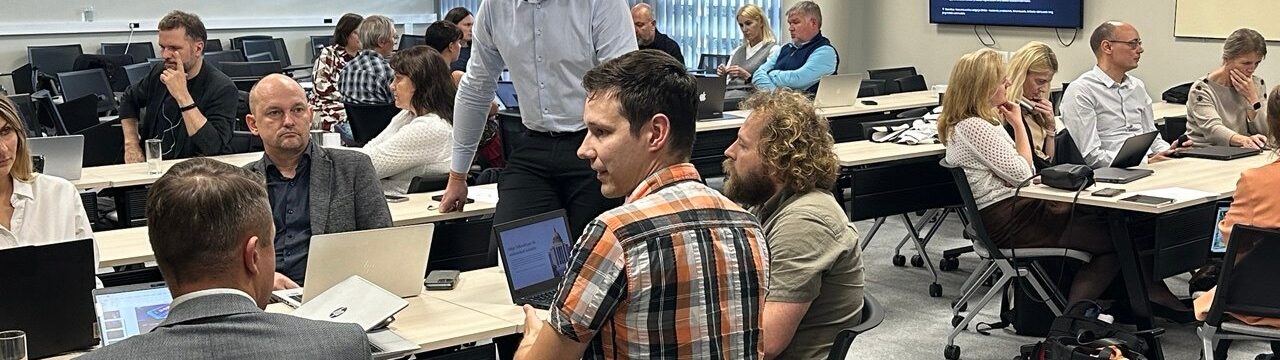
In the autumn semester of 2025, we carried out one of the largest AI-themed cluster hackathons of recent years at the School of Information Technologies, involving 120 companies and 150 students over the course of the autumn. The initiative was born partly out of companies’ concerns – more and more companies today feel that although AI is everywhere, it also creates uncertainty – including questions such as: Where to start? How to use AI safely? How to ensure accuracy when real data comes into play? Many questions were also circulating among students and lecturers – primarily related to what the labour market in the AI era actually expects.
To address these questions systematically, we created a multi-part series of activities that connected companies, training programmes, and students into a single whole. In mid-August, we launched an AI implementation training programme for entrepreneurs, attended by more than 120 companies. Each week, 1.5-hour virtual training sessions took place, during which participants learned about and experimented with various AI tools.
The training series culminated in the second half of September with the ThinkTank hackathon held at IT College, where representatives of nearly 100 companies automated one of their company’s processes using AI tools in just 8 hours. It was during the ThinkTank hackathon that, with the companies’ consent, we collected real problems and ideas that they face in their everyday use of AI.
These same problems were then passed on to students to “hack.” This allowed companies to articulate and hand over their concerns to students without expecting them to spend long hours on-site as mentors. At the same time, students were able to work on tasks with real context rather than abstract examples or theoretical exercises. From September to mid-November, students learned about the capabilities of AI tools as part of a course, and in mid-November we brought 150 students together in 40 teams to start solving the problems collected from companies. The result – all teams reached genuinely working prototypes, and some even solutions that were immediately ready for implementation.
We experienced that such a multi-level and combined model works exceptionally well. Entrepreneurs gained clarity on which processes make sense to automate and how this could work in practice. For students, this was also an eye-opening experience: they saw very clearly what companies are actually doing with AI today – and what they are not yet doing. And how the courses still ahead in the curriculum will help them acquire skills that they felt were lacking during the hackathon.
It became especially clear that simple so-called off-the-shelf solutions quickly fall short. When large databases and the need for accuracy, reliability, and security come into play, AI development becomes significantly more complex. This is precisely where students’ future contribution will be critical – not only in using models, but in understanding systems, ensuring data quality, and applying solutions responsibly. At the same time, today’s intuitive AI tools make it possible to quickly create and test solutions before moving on to so-called real development.
We definitely want to continue similar multi-level collaboration models at the School of Information Technologies in the future, where real problems from companies flow smoothly into teaching and give students the opportunity to gain early insight into what is happening in the field and the relevance of what they are learning at university.
A longer story on Trialoog: https://trialoog.taltech.ee/hakaton-mis-lahendas-paris-valjakutseid/